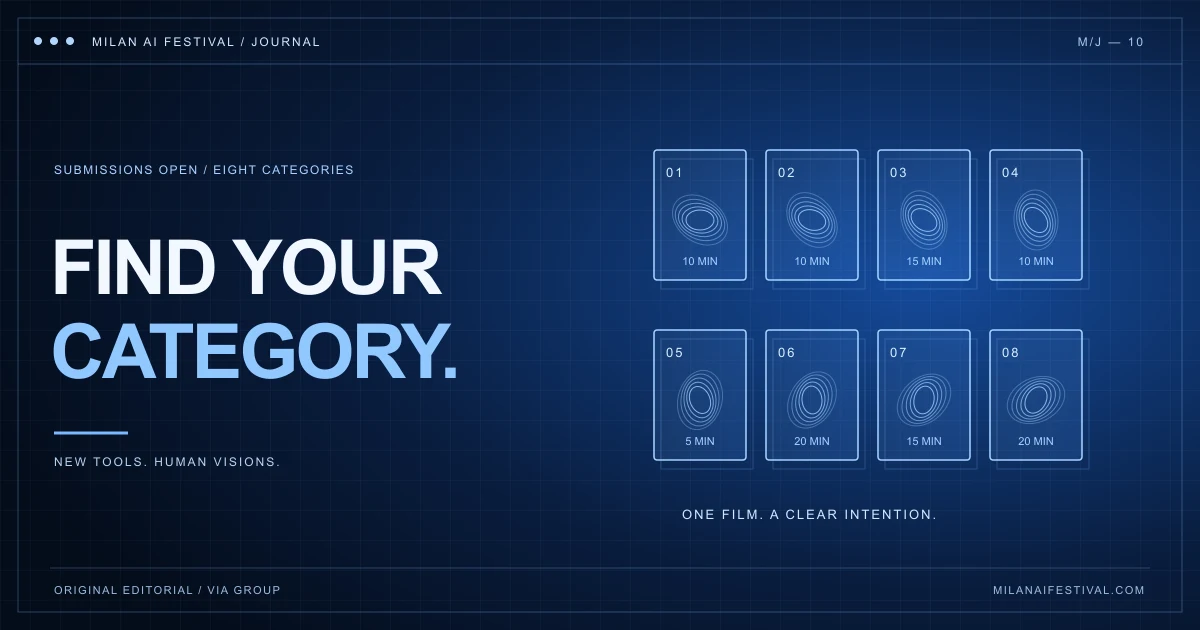
Milan AI Festival is accepting submissions on FilmFreeway for its first edition on 15 April 2027 at Cinema Anteo, Milano. Choose among eight categories by the work’s main purpose, then check its runtime and any student or Italian eligibility conditions. Read the current listing before submitting; this guide helps you make a clear category choice and prepare your entry.
Start with what the film asks an audience to notice
The official Milan AI Festival FilmFreeway listing, checked on 27 October 2026, is open for entries. The festival is organised by VIA Group — Visual Innovation Awards. Its categories span cinema, fashion, design and work made for live or spatial settings. You can explore them visually in the Milan category playground.
Before choosing a category, finish this sentence: ‘The audience should leave thinking about…’ A garment collection, an imagined building, a city’s social rhythm and a character’s dilemma point towards different kinds of work. A film can contain all four; the useful question is which one gives it a reason to exist. This is our editorial method for comparing categories, not an additional judging rule.
Make that decision using the finished film, not only the original pitch. A project that began as an architectural study might have become a character story during editing. Watch the export without its synopsis and write down what actually carries the experience. Then compare that observation with the category descriptions.
Fashion, design or metropolis: identify the subject
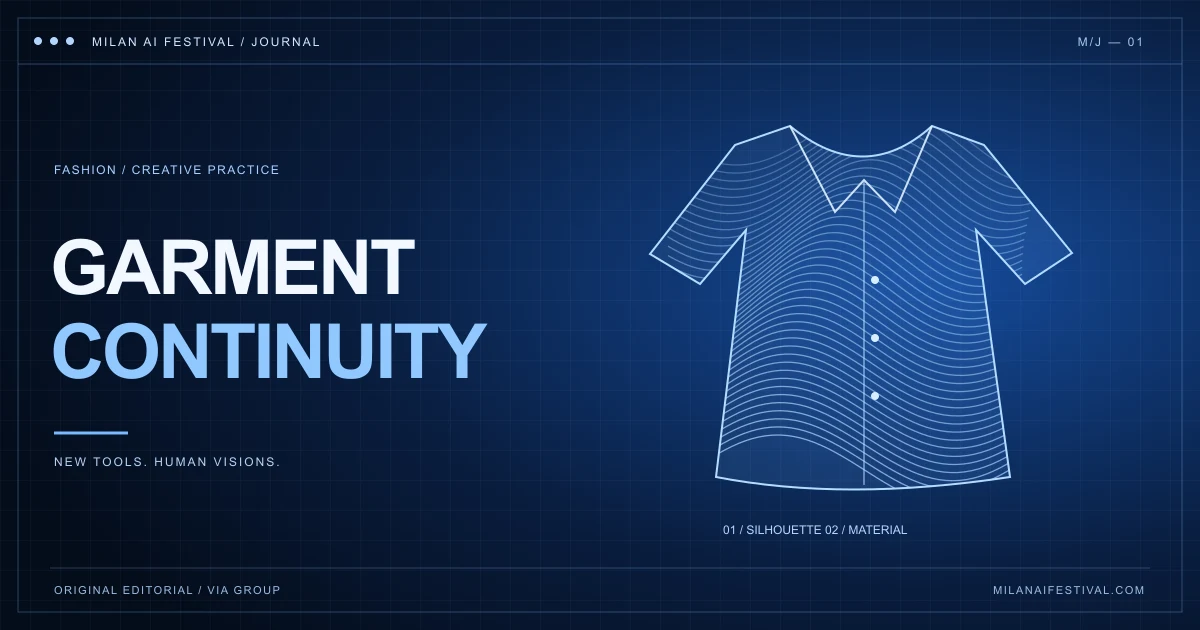
Best AI Fashion Film — maximum 10 minutes. This is the category for fashion films, moving lookbooks, runway concepts and designer storytelling, including real or imagined brands. A useful editorial test is whether styling, garments or a collection drives the sequence. If the clothing could be replaced without changing the film’s central idea, look carefully at whether another category describes it better. Our garment continuity guide can help you review the work before entry.
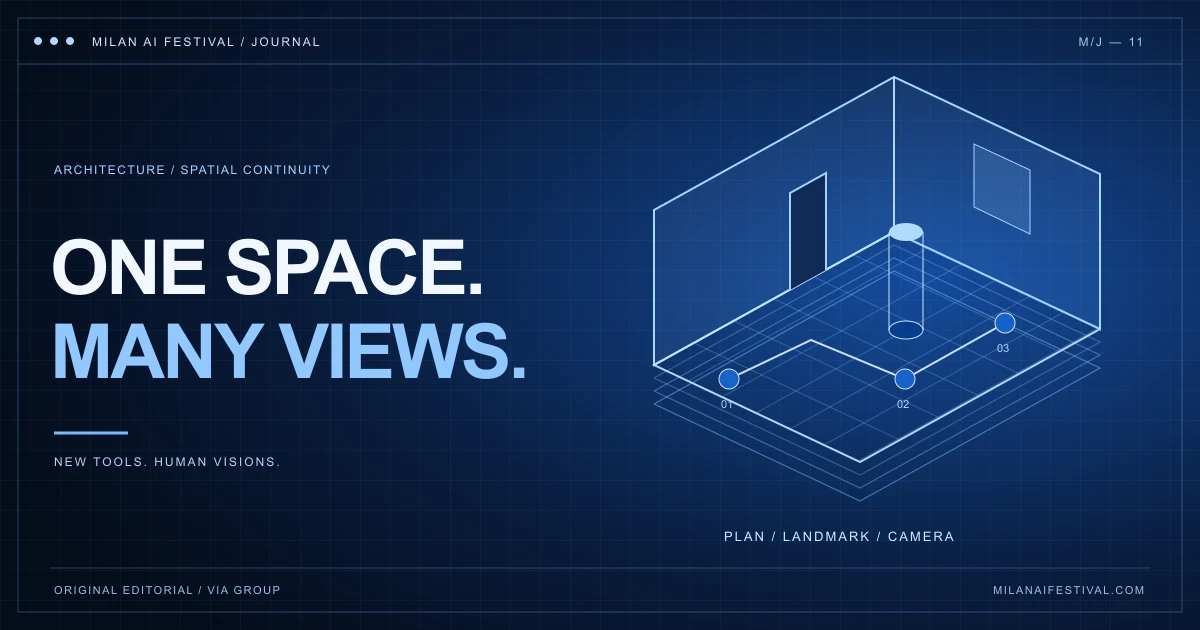
Best AI Design & Architecture — maximum 10 minutes. The focus can be a product, an interior, a building or a speculative space. Consider whether the edit communicates relationships between form, scale, materials and use. An imagined chair might be explored through proportion and movement; a building might be explored through how spaces connect. Those are possible creative approaches, not mandatory shots.
Best AI Metropolis — maximum 15 minutes. Here the city is the protagonist, whether Milan or another real or imagined metropolis. To distinguish it from architecture, ask what happens between the buildings: movement, routines, conflict, density, memory. A skyline can establish a setting, but the city becomes the subject when its life or structure determines what the film is saying. Any genre is welcome.
Performance, pitch or narrative: identify the form
Best AI Audiovisual Performance — maximum 10 minutes. This includes work for concerts, clubs, projection mapping, installations and immersive settings. Submit documentation or the visual piece itself. If you choose documentation, consider whether viewers can understand the relationship between the images and the space. A sequence of close-ups may show visual detail while hiding the scale or audience perspective that makes the work distinctive.
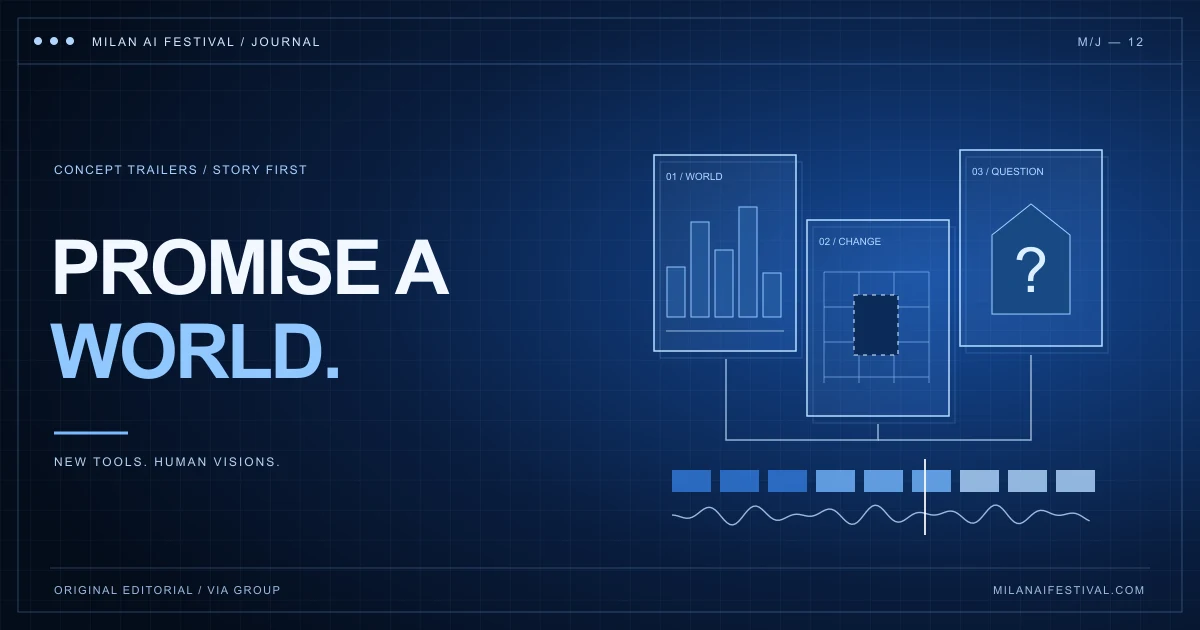
Best AI Trailer & Concept Pitch — maximum 5 minutes. Use this for a trailer, teaser or proof of concept for a film or series that does not yet exist. A useful pitch makes a specific promise: whose world will we enter, what pressure shapes it, and why would we want more? It need not pretend to be a completed short. The title, synopsis and submitted piece should describe the same stage of development.
Best AI Narrative Short — maximum 20 minutes. This category centres fiction with characters and plot, created primarily with AI tools. A hypothetical film about a courier crossing a future city could fit here if the courier’s choices drive the story. If the same journey primarily reveals how that city functions, Metropolis may describe it more clearly. Neither label is automatically stronger; explain the work you actually made.
Student and Italian categories: check who can enter
Best AI Student Film — maximum 15 minutes. The category is open across genres to students currently enrolled in a university, film school or academy; proof of enrolment is required. Best Italian AI Film — maximum 20 minutes — is open across genres to Italian directors or Italian-based productions. These categories introduce eligibility conditions rather than a single visual style.
Keep the eligibility decision separate from the creative description. A student film still benefits from an accurate synopsis, and an Italian production still needs to explain its AI process. If your production situation is unusual, ask through the official listing before paying. Do not assume that shooting an Italian location alone establishes eligibility, or that a past course means current enrolment.
Prepare the AI Statement as a readable account of the work
The current FilmFreeway rules require a 100–300-word AI Statement in the submission notes, explaining tools, workflow and the parts of the film they produced. Generative AI must make a significant creative contribution; hybrid work is welcome. Consult the listing’s Rules & Terms for the complete conditions.
A useful way to draft the statement is to work from the final timeline backwards. Identify generated images or clips, synthetic sound or voices where used, and any filmed, performed or manually created material. Then describe the main stages of selection, compositing and editing. A tool name alone cannot tell the reader whether it created a background, an entire sequence or a temporary reference.
Spend the remaining words on one concrete creative decision. Explain what you changed and what that change accomplished in the film. Avoid filling the statement with claims that the workflow was revolutionary. A short, accurate explanation is more useful than a large list of software. Our project breakdown guide provides a longer working method that you can condense into the required statement.
Check the actual export and the actual submission
The published runtime limits include credits. The listing also requires English subtitles for films in other languages and says online screeners must remain accessible and unchanged until notification. Entering one film in several categories requires a separate entry and fee for each. Check current fees and deadlines directly on FilmFreeway before paying.
For your own final review, open the exact screener link you intend to submit, play the beginning and end, and check the full duration. Test access without relying on the account that uploaded it. Watch captions on a small screen, listen for missing audio, and compare the title and credits with the application. This is a practical quality check, not a substitute for the platform’s submission instructions.
Keep a dated copy of your synopsis, AI Statement and submitted version name. That makes it easier to answer a later question without reconstructing what was sent. If you spot an error after submission, use the official contact route before changing a screener that the rules say should remain unchanged.
After submitting, keep programme planning separate
A submitted film is not an announcement of selection, a screening slot or audience admission. Save the platform’s confirmation and follow official messages about your entry. For attendance, use the Milan festival information page; the event date and venue are confirmed, while the public programme, start time and ticket details remain to be announced.
Milan sits within VIA’s wider festival family alongside Rome AI Festival and Florence AI Festival. Each event has its own programme and entry conditions. Use the Milan organiser page for the network and contact routes, and return to Milan’s own FilmFreeway listing when deciding how to enter this edition.